
Hacker Culture · History · Philosophy
Before Cybersecurity Became an Industry, There Was Hacker Culture
Many people entering cybersecurity today may never have actually experienced hacker culture. Not the real kind. Not the strange, obsessive, curiosity-driven internet culture that existed long before cybersecurity became a career path, an industry, or a LinkedIn category.
Today, most people discover cybersecurity through certification roadmaps, bootcamps, CTF platforms, influencers, and training subscriptions.
But for many of us, it started very differently.
A Personal Entry Point
Somewhere around 2002 or 2003, I got access to a Windows 2000 machine. Like most kids growing up around that era, I was obsessed with games — Wolfenstein 3D, Prince of Persia, Roadrash, later GTA.
But somewhere along the way, computers stopped feeling like devices and started feeling like worlds waiting to be understood.
When I finally got my own computer in 2007, I was not trying to become a cybersecurity professional. I was writing C programs. Experimenting with graphics. Building a football field in computer graphics because I thought it looked beautiful.
I was never exceptional academically in the traditional sense. I struggled with theory papers. But I loved understanding how systems behaved.
Then I stumbled upon The Art of Deception by Kevin Mitnick.
That book changed my life. Not because it taught me “hacking techniques.” But because it introduced me to a completely different way of looking at systems, technology, psychology, and authority itself.
That was my entry into hacker culture. And the internet back then felt completely different.
How Knowledge Moved Then
IRC channels
Forums & BBS systems
Textfiles & mailing lists
Yahoo Messenger chats
Pseudonymous communities
Brazilian hackers teaching SQL injections freely over IRC. Not selling mentorship packages. Not building personal brands. Just curiosity-driven knowledge exchange.
Hacker Culture Was Never Just About “Hacking”
One of the biggest misunderstandings today is reducing hacker culture to cybercrime. That was never the full story.
What Hacker Culture Actually Represented
Curiosity without permission
Learning outside institutions
Questioning authority
Understanding systems deeply
Freedom of information
Open knowledge sharing
Privacy as a value
Technical creativity
Intellectual rebellion
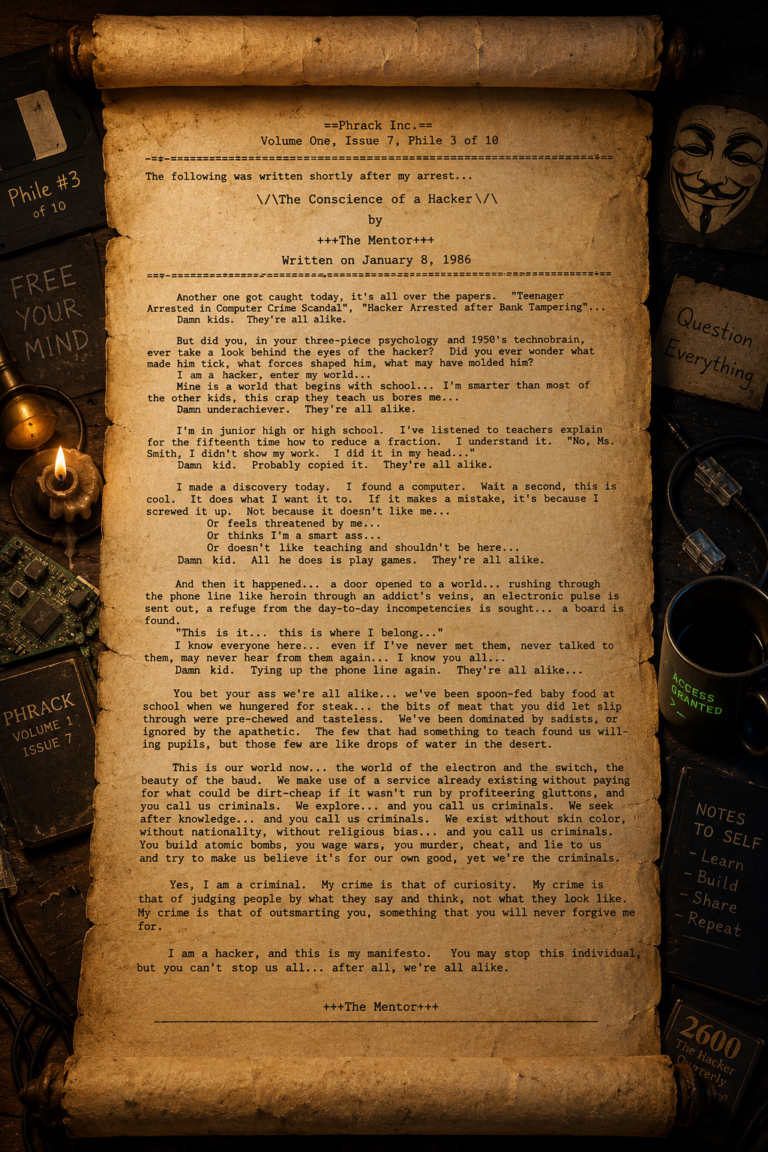
When many of us first read The Hacker Manifesto, it did not feel like reading a criminal confession. It felt like reading the thoughts of people who found refuge in computers because curiosity mattered more there than social status, conventional success, or institutional approval.
Computers created a space where intelligence, curiosity, and exploration mattered more than conformity. That spirit existed all across early hacker culture.
Communities That Carried the Culture
IRC communities
Phone phreaking culture
Underground forums
Early reverse engineering circles
Privacy movements
2600: The Hacker Quarterly
Phrack magazine
Legion of Doom
Masters of Deception
Anonymous
The Internet Used to Reward Technical Reputation Differently
There was a time when reputation inside hacker culture came less from visibility and more from technical credibility among peers. Handles mattered. Research mattered. Writeups mattered. Reverse engineering mattered.
Then vs Now
Then — Reputation came from
→ Peer recognition
→ Technical depth
→ Research quality
→ Community respect
Now — Visibility comes from
→ Certifications
→ Conference selfies
→ Influencer culture
→ Engagement metrics
There was a site called Zone-H where web defacements were archived publicly. Most outsiders saw chaos. But culturally, Zone-H represented something important about that era: technical reputation existed independently of institutional approval.
People wanted respect from communities that valued technical depth — not visibility from audiences chasing content. The aesthetics of hacker culture survived. The philosophy often did not.
Cybersecurity Did Not Kill Hacker Culture
This is the important distinction. Cybersecurity becoming an industry was not inherently bad. The world genuinely needs defenders. Organizations need security professionals. People deserve careers.
But industries optimize differently than cultures do.
Industries optimize for
→ Scalability
→ Hiring pipelines
→ Certifications
→ Frameworks
→ Monetization
Hacker culture optimized for
Curiosity.
Once cybersecurity industrialized, curiosity slowly stopped being the center of the ecosystem. That does not mean hacker culture disappeared. It simply became quieter. Less visible. Less commercial. Less algorithmically rewarded.
Many OG hackers are still around. Not necessarily on keynote stages or LinkedIn feeds. But quietly researching, reversing, building, documenting, teaching, and exploring systems because they still genuinely want to understand them.
The Point
Hacker culture was never just about hacking systems.
It was about refusing to stop being curious about them.
The views and opinions expressed in this article are personal and belong solely to the author. They do not represent the views of any employer, organization, or affiliated entity.